Here are summary notes to help you prepare for the upcoming unit assessment.
Thanks to Mr Noble for sharing his notes!
E-Book PDF: Open in New Window | Download
with mr mackenzie
Here are summary notes to help you prepare for the upcoming unit assessment.
Thanks to Mr Noble for sharing his notes!
E-Book PDF: Open in New Window | Download
This document will help you to generate ideas for your assignment.
E-Book PDF: Open in New Window | Download
Here is the document you will need for the earthquakes assignment. We have equipment for you to carry out practical activities 2 and 3. You will also need the Audacity guide.
E-Book PDF: Open in New Window | Download
We’re going to start the researching physics unit and assignment next week. Before we go to the computer room, please watch the attached video so you will have some ideas about the science of earthquakes and how they can be detected.
This is a large video file – make sure you are connected to wifi before downloading.
Please do not stream the video as this will prevent others from viewing at the same time. Download the file before you start to watch.
Podcast: Play in new window | Download
We met refraction during the National 5 course. At Higher level, we are interested in the relationship between the angles of incidence θi and refraction θr.
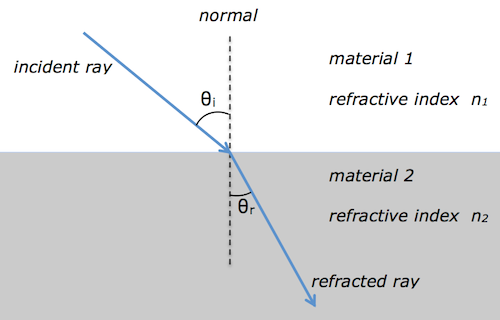
Snell’s law tells us that
n_1\sin \theta_i = n_2 \sin \theta_r
Usually material 1 is air, and so n_1 = 1. This simplifies Snell’s law to
\sin \theta_i = n \sin \theta_r
where n is the absolute refractive index of material 2. Since the refractive index is equal to the ratio of the ray’s speed v in materials 1 & 2 and also equal to the ratio of the wave’s wavelength λ in materials 1 & 2, we can show that
n = \displaystyle {{{\sin \theta_i} \over {\sin \theta_r}}} = \displaystyle {v_1 \over v_2} = \displaystyle {\lambda_1 \over \lambda_2}
Read more about Snells’s law here.
\sin \theta_c = \displaystyle {1 \over n }
Here are some applications of total internal reflection here. You can test your knowledge of refraction with this interactive simulation.
I have attached a pdf with some notes and questions on refraction, total internal reflection and critical angle.
E-Book PDF: Open in New Window | Download
The second programme is all about the current state of car safety.
We follow a car safety team at Volvo as they prepare to crash two cars together to collect forces data, learn how emergency medicine procedures are changing to improve outcomes for car accident casualties, and learn how sensors are used to monitor the human body’s response to a collision.
Please watch both programmes before Thursday 18th February.
As with the first video, please check you are connected to wifi before downloading as the video file is quite big.
Podcast: Play in new window | Download
We’re going to start work on the assignment task next week. You’ll spend 2-3 periods researching car safety online and choosing a particular topic to explore in more depth. Before we go into the ICT room, I’d like you to watch two videos about car safety.
The first programme looks back at the history of car accidents and the work that has been done to reduce deaths on the road. While many of the clips shown are quite old, they show just how far we have come in our understanding of the science behind making cars more safe.
Please right click on the link below and save your own copy of the file, rather than streaming it.
Check you’re using wifi before downloading – it’s a big file!
Podcast: Play in new window | Download
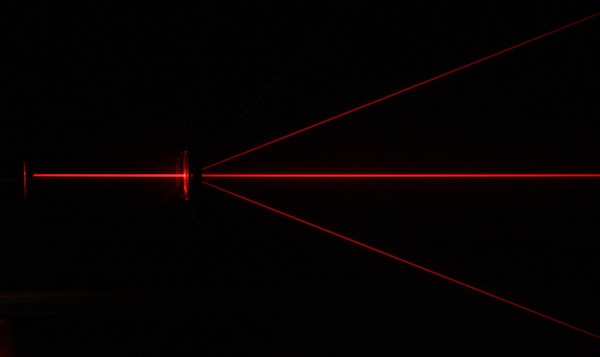
Diffraction is a test for wave behaviour. When a ray of light passes through a diffraction grating, the energy of the incident beam is split into a series of interference fringes. Constructive interference is occurring at each location where a fringe (or spot) is observed because the rays are in phase when they arrive at these points.
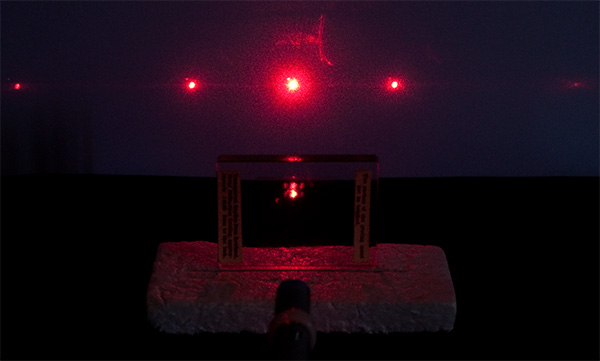
Find out about diffraction gratings here.
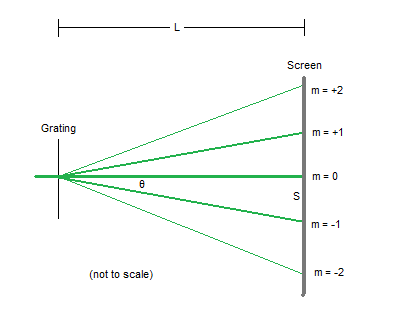
We can measure the relative positions of the fringes in a diffraction pattern to determine the wavelength of the light used. The diffraction grating equation is
m \lambda = d \sin \theta
where
Here is an infrared diffraction experiment you can try at home to calculate the wavelength of the infrared LED in a remote control.
I’ve attached a set of pdf notes and questions on diffraction. These notes use n rather than m for the diffracted order.
E-Book PDF: Open in New Window | Download
We learned about the photoelectric effect this week. This video has a similar demonstration to the gold leaf electroscope experiment I showed you in class and includes an explanation of the process.
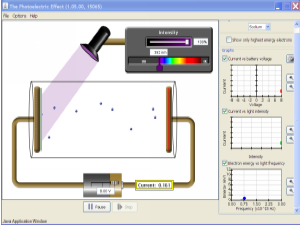
Once the animation is running, you can;
Notice that below the threshold frequency you can’t get any photoelectrons, even if you set the light to its brightest setting.
Compare your results to the graphs provided in your notes.
I have attached some notes & questions on the photoelectric effect. Click on the link below to download a copy.
E-Book PDF: Open in New Window | Download
I’ve attached a set of notes to help with your revision for the Our Dynamic Universe resit on Tuesday. Remember that the resit paper will have knowledge questions only, so focus on the unit content during your revision rather than practising numerical problems.
Thanks to Mr Noble for sharing his ODU notes.
E-Book PDF: Open in New Window | Download