
We met refraction during the National 5 course. At Higher level, we are interested in the relationship between the angles of incidence θi and refraction θr.
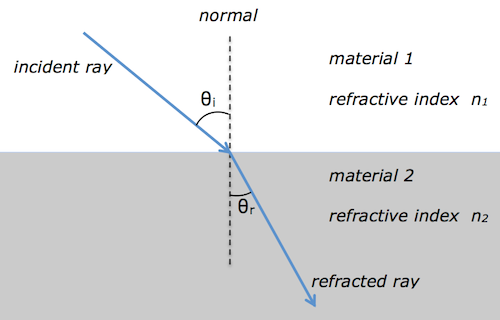
Snell’s law tells us that
n_1\sin \theta_i = n_2 \sin \theta_r
Usually material 1 is air, and so n_1 = 1. This simplifies Snell’s law to
\sin \theta_i = n \sin \theta_r
where n is the absolute refractive index of material 2. Since the refractive index is equal to the ratio of the ray’s speed v in materials 1 & 2 and also equal to the ratio of the wave’s wavelength λ in materials 1 & 2, we can show that
n = \displaystyle {{{\sin \theta_i} \over {\sin \theta_r}}} = \displaystyle {v_1 \over v_2} = \displaystyle {\lambda_1 \over \lambda_2}
Read more about Snells’s law here.
total internal reflection
\sin \theta_c = \displaystyle {1 \over n }
Here are some applications of total internal reflection here. You can test your knowledge of refraction with this interactive simulation.
I have attached a pdf with some notes and questions on refraction, total internal reflection and critical angle.

E-Book PDF: Open in New Window | Download