We’ve been looking at wave-particle duality this week.
Here are 2 videos. The first is about electron diffraction (G. Thomson’s experiment) and De Broglie’s equation, while the second looks at the Davisson-Germer experiment.
Following on from our discussion of the Davisson-Germer experiment, I found a copy of Davisson’s Nobel Lecture online. You can read it using the download link below. You should be able to follow Davisson’s lecture as it ties in nicely with the modern physics element of the AH course.
Sorry for the long wait! Here are worked solutions to the homework questions on calculus and special relativity. Come and see me if you want to go over any of them. Thanks.
Congratulations to Peter Higgs and Francois Englert on winning the 2013 Nobel Prize in Physics in recognition of their work on the particle we call the Higgs Boson. Here’s a video that may help to explain why this particle is so important to physicists.
We’ll spend the next two lessons in the library learning how to use Excel. Download the instructions using the link below. If you have your own LO3 data, feel free to work with those values instead of the numbers I have provided.
By the end of this activity you will be able to;
manipulate raw data using formulae in cells
plot a graph of your results
add error bars to your graph
add a line of best fit
calculate the gradient and y-axis intercept of your line
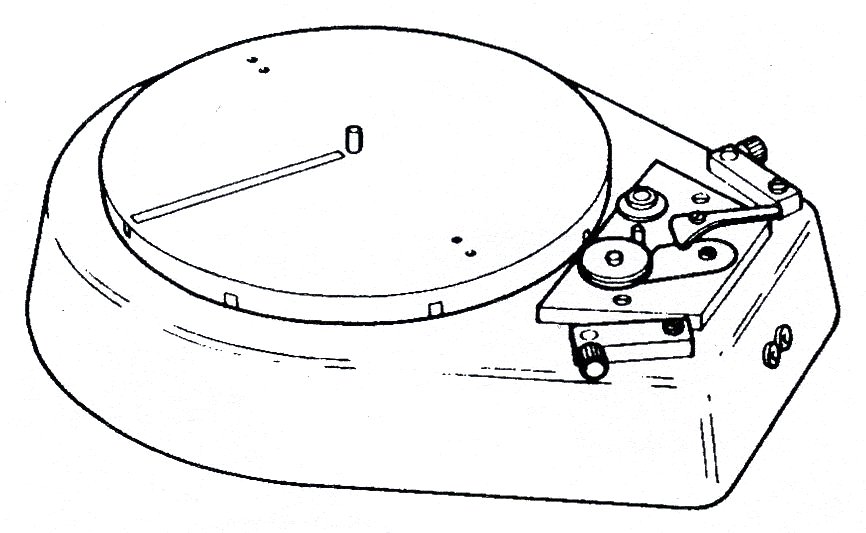
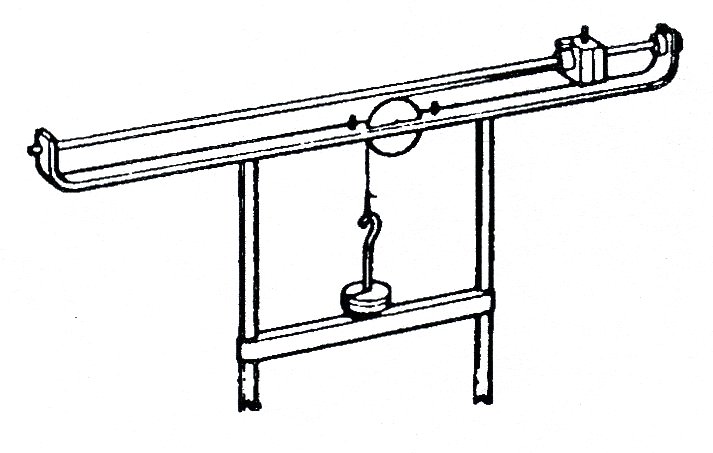
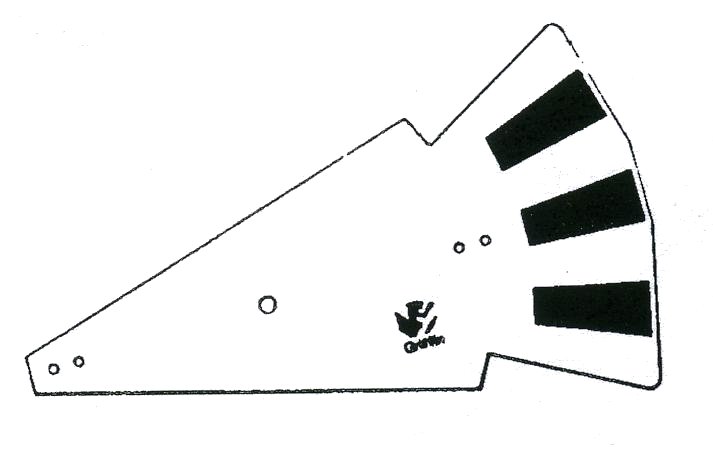
Here are the diagrams you will need for your LO3 report. Cick on each link and then save the large image that opens up. You can rezise them once they have been imported into your report.
Later this week, we’ll look at how you can use a spreadsheet to process the data you obtained.
The first laser was demonstrated in 1960 by Theodore Maiman and his research group at Hughes† in California. Here is a good background article on the first laser, its inventor and the role that Einstein played in developing the theory of stimulated emission.
The principle of laser operation is outlined in this description of Maiman’s laser, which used a rod of polished ruby inside a spiral flashtube.
My favourite James Bond film, Goldfinger, has a scene where Sean Connery (the best 007 imho) is strapped to a table under a huge red laser. It should have been a saw but the invention of the laser, just 4 years earlier, was a gift for the writers. This scene helped the film win the best effects Oscar in 1965 and, more importantly, gave us the ultimate Bond quote:
Bond: Do you expect me to talk?
Goldfinger: No, Mr. Bond, I expect you to die.
Everyone should watch the laser scene.
Bonus points if you can tell me about the bad physics in that clip…
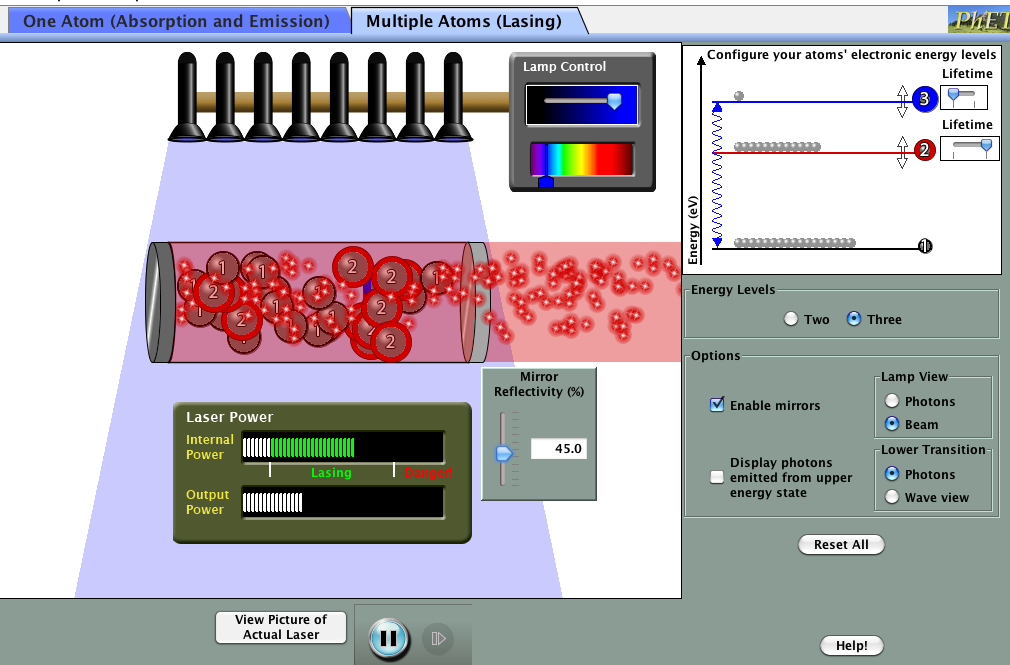
You can try running a laser for yourself. Click on the picture below to load a simulator. You’ll need Java on your computer to run the simulation.
Try changing lamp (pump) irradiance and mirror reflectivity on the single atom version before moving on to the multiple atom tab.
There are some pdf notes on lasers attached to the end of this post.
† Disclaimer: I used to work for Hughes before I trained as a physics teacher – the Glenrothes branch, not California 🙁