Here are some summary notes for those of you about to resit the Dynamics and Space unit assessment. Don’t forget that there is additional material available on BBC Bitesize.

E-Book PDF: Open in New Window | Download
with mr mackenzie
podcasts go in this category for the feed to iTunes
Here are some summary notes for those of you about to resit the Dynamics and Space unit assessment. Don’t forget that there is additional material available on BBC Bitesize.
E-Book PDF: Open in New Window | Download
Here are the summary notes to help with your revision. You can get extra revision material on BBC Bitesize. The unit assessment for Dynamics & Space will be on Friday 6th March.
E-Book PDF: Open in New Window | Download
You recently completed the topic on capacitors in dc circuits, finishing off with a detailed study of the graphs obtained for current & voltage against time when a capacitor is charged or discharged through a series resistor. There are some additional notes and practice questions at the end of this post but please watch the embedded video clips first.
The S-cool revision site has some helpful notes and illustrations on capacitor behaviour; try page 1 (how capacitors work) and page 2 (charging and discharging).
There is information on charging and discharging capacitors on BBC Bitesize.
Here is a video that covers some of the areas covered in your printed notes. Ignore the maths at the end of each section of the film, you won’t need it. Notice how the man in the film uses a lightbulb, rather than an ammeter, to show when the current is large or small. Clever, eh?
You must be explain how a flashing neon bulb can be controlled using a capacitor & resistor arranged in series. Here is a short video introduction to help with that.
[vimeo 29198676 w=500 h=281]
Blinking Neon Bulb (5F30.60A) from Ricardo Alarcon on Vimeo.
There are people working to replace heavy battery packs with modern, high capacitance devices called supercapacitors. These supercapacitors have superior energy storage compared to the normal electrolytic capacitors you will have used in class. This video goes one step further and shows the fun you could have with an ultracapacitor. Do not try this at home!
[vimeo http://www.vimeo.com/27087359 w=400&h=225]
Of course, you can always make your own capacitor with paper and electrically conductive paint.
[vimeo http://www.vimeo.com/34079522 w=400&h=220]
Finally, you looked at capacitors in ac circuits. You need to know that a capacitor will allow an ac current to flow. The current in such a circuit will increase as the current increases. Mr Mallon’s site has a revision activity about capacitors in ac circuits.
Now download the pdf below. It contains notes to help with your prelim revision and some extra capacitor problems.
Thanks to Fife Science for the original pdf from Martin Cunningham.
E-Book PDF: Open in New Window | Download
Earlier in unit 2, you worked in groups to complete an experiment on internal resistance. Listed as “Method 2″ on page 8 your printed notes, you built a simple series circuit using a cell, a resistance box and an ammeter. A voltmeter was connected across the resistance box and you recorded the voltage across (TPD) & current through the resistor as you changed the resistance from 0.5Ω to 1.5Ω in steps of 0.1Ω. The aim was to draw a graph of your data and use this plot to determine the internal resistance of the cell.
The video below shows the same type of experiment, but uses a potato and two different metals in place of a normal cell. Watch the video and note the values of I and V each time the resistance is changed – remember to pause the video each time so you can write the results. Just scroll back if you miss any.
Now plot a graph with current along the x-axis and TPD along the y-axis. If you don’t have any sheets of graph paper handy, there is a sheet available to download using the button at the end of this post. Or you could try printing out a sheet from a graph paper site, use Excel or download the free LibreOffice.org Calc spreadsheet.
Draw a best-fit straight line for the points on your graph and find the gradient of the line. When calculating gradient, remember to convert the current units from microamps (uA) to amps (A).
The gradient of your straight line will be a negative number. The gradient is equal to -r, where r is the internal resistance of the potato cell used in the video.
You can obtain other important information from this graph;
E-Book PDF: Open in New Window | Download
With the school closure today, I’ve posted some revision work for the Wheatstone Bridge. Please read through the revision section and attempt the questions in the attached pdf.
We’re coming to the end of the topic that investigates the behaviour of a Wheatstone Bridge. The bridge circuit is really just a pair of potential dividers (voltage dividers) dividers connected in parallel. A voltmeter, ammeter or galvanometer (very sensitive ammeter) connects the two potential divider chains together, as shown below.
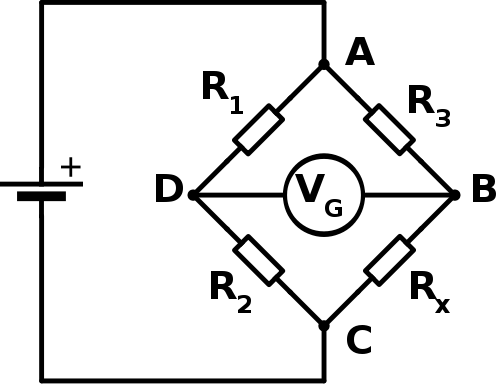
When the voltage (or current) displayed on the meter is zero, we say that the Wheatstone bridge is balanced. For a balanced bridge, it is possible to show that
\displaystyle {R_1 \over R_2} = \displaystyle {R_3 \over R_4}
[you have this proof in p11 of your notes folder]
For the circuit shown above, the voltmeter will display the difference in electrical potential between points B and D. We can calculate this potential difference by finding the voltages at points B and D using the voltage divider equation you used for National5/Standard Grade/Intermediate 2 Physics.
V_2 = \displaystyle { R_2 \over {R_1+R_2}} \times V_s
So in this example,
V_D = \displaystyle {R_2 \over {R_1+R_2}} \times V_s
and
V_B = \displaystyle {R_X \over {R_3+R_X}} \times V_s
The voltmeter displays the potential difference between these two points, i.e.
V_G = V_D-V_B
Here is a short video that provides a recap of the Wheatstone Bridge.
and a worked example from an old SQA past paper
Now click on the picture below to try an interactive Wheatstone Bridge problem (you will need to have Java installed).
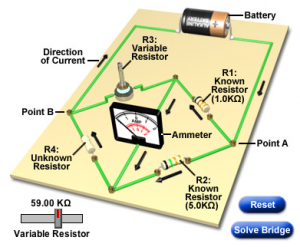
Instructions:
You can repeat this simulation as many times as you like by pressing Reset to change the resistor values…..it’s great practice!
Here is an example of an application of the Wheatstone Bridge, called the metre bridge.
When a Wheatstone Bridge is slightly out of balance, it will provide a linear response. In other words, small changes in resistance will produce proportionally small changes in voltage or current. When these small changes are plotted, we obtain a straight line through the origin, like this:
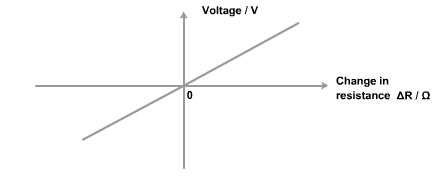
This property of a Wheatstone Bridge can be used to find the temperature of the physics classroom if one of the resistors is replaced with a thermistor – see p14 of your notes. The thermistor is immersed in a beaker of ice & water (I used snow one year – see photo) and the Wheatstone Bridge is balanced while the thermistor is cold. Note the temperature of the ice/water mixture and the reading on the galvanometer.
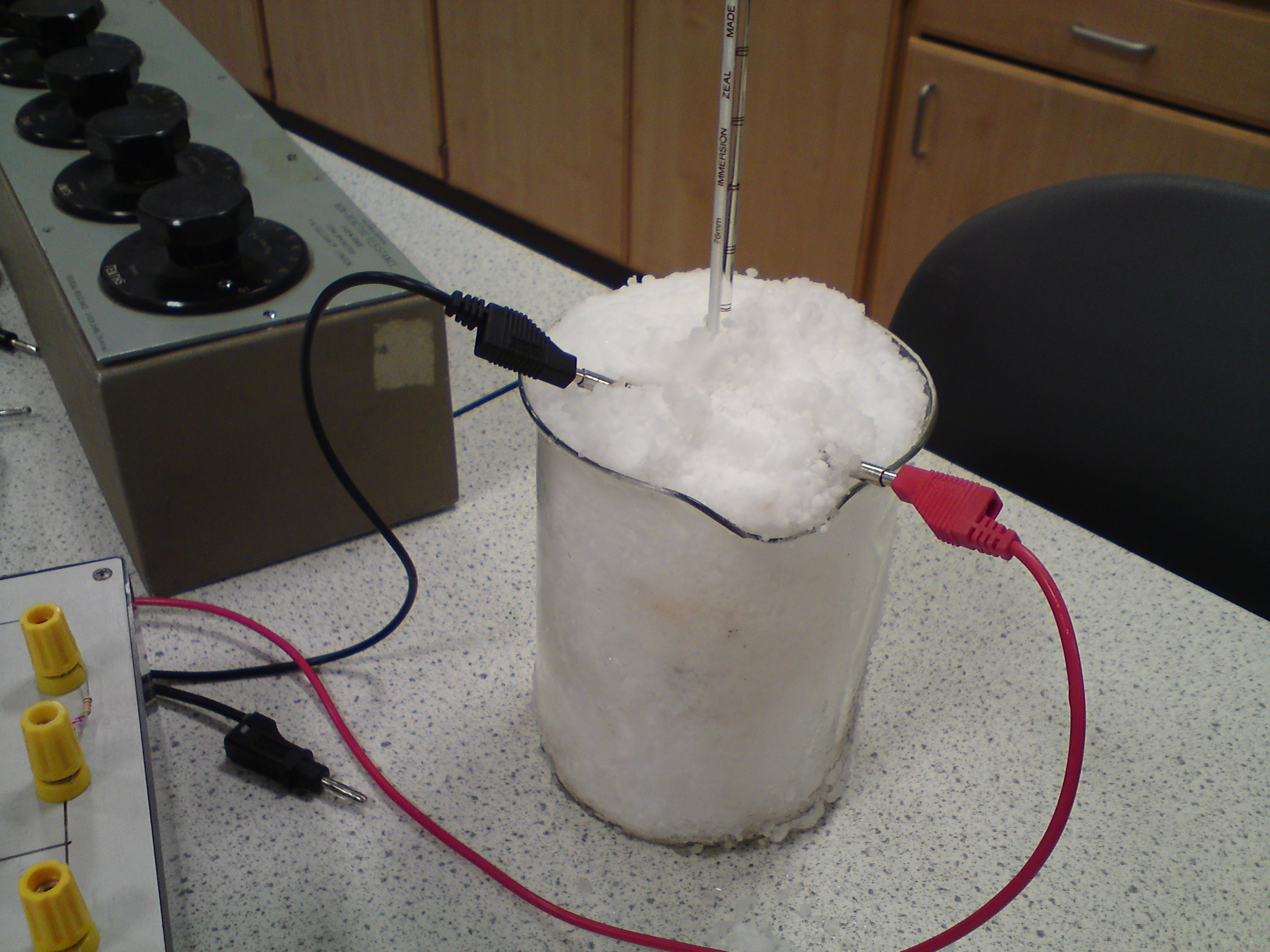
Without touching the resistance box settings, the thermistor is placed in warm water and the reading on the galvanometer is recorded, along with the water temperature. Now plot these two points on a graph, with temperature on the x-axis and current on the y-axis. Draw a straight line between the two points (I know, I know!)
Remove the thermistor from the beaker and leave it sitting on the desk for a few minutes. Check the new galvanometer reading and use your graph to find which temperature would give this value for current.
When we did this on Monday (5.5 class), we found that the graph predicted a room temperature of 14°C, 20°C or 25°C, depending on the group. The digital thermometer in the corner of the room showed 17°C. Why is there a difference?
As we discussed on Monday, this experiment is flawed due to the way resistance of a thermistor changes with temperature (you might remember this from Nat5/SG/Int2).
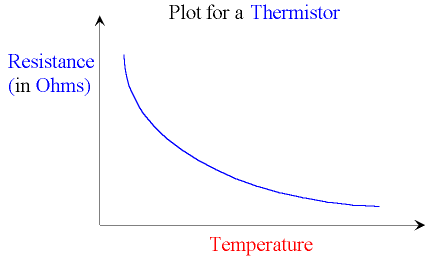
Since the resistance is not proportional to temperature, we will not get an accurate answer…..unless we stay very, very close to the temperature at which we balanced the Wheatstone Bridge. In this case, we tried to cover too large a range of temperatures. For temperature ranges much smaller than the 80°C we attempted, it is possible to obtain an accurate estimate of room temperature.
Click on the download link below to try some Wheatstone Bridge questions.
E-Book PDF: Open in New Window | Download
Here is Stephanie Bell‘s booklet – A Beginner’s Guide to Uncertainty of Measurement. There’s a lot of useful information in here, so please do have a read during the holidays. If you see any issues in here that might affect what you are doing with your procedures or data handling, please let me know.
E-Book PDF: Open in New Window | Download
Here is the second uncertainty guide. It is a more recent document and covers Higher in addition to Advanced Higher. You’ll probably find page 11 onwards has the most relevant information for investigation work.
E-Book PDF: Open in New Window | Download
Here is the first of the uncertainty documents to help you with your investigations.
The final page will help you to quantify some of the calbration uncertainties in instruments. If you use these values, remember to reference Learning & Teaching Scotland as the original source of the booklet.
E-Book PDF: Open in New Window | Download
Here are your summary notes for the Nat4 unit on electricity and energy. Remember that the end of unit test will be on Monday 3rd November. Ask me next week if you have any questions.
There are revision materials for this unit on BBC Bitesize.
E-Book PDF: Open in New Window | Download
We’re going to the library for the next few periods. Download the instructions using the link below. Use your own LO3 data instead of the numbers I have provided.
By the end of this activity you will be able to;
E-Book PDF: Open in New Window | Download