With all of the Physics courses coming to an end, there will be prelims to sit before you go on study leave. Please check the updated list of prelim arrangements on the calendar so you know when your exam will be.
Higher
vulcan laser
How cool a name is that?
Vulcan is the highest intensity (do you think they mean highest irradiance?) laser in the world and it’s in a British research laboratory. Watch the video to learn more about it.
httpv://www.youtube.com/watch?v=P5WltfXcq9A
I wonder if Peter has read the comments under this video on the youtube site?
bang goes the theory – a homemade laser
We’ve just studied stimulated emission and how it can be used to make a laser. I noticed the BBC1 schedule for this week says that Jem is going to make his own laser in this week’s programme. BBC1 Scotland will show the programme on Friday 15th April at 20.30.
You should be able to watch it online before then – look for episode 5 of series 4 on iPlayer. Here is the trailer.
Goldfinger’s laser – update
Just one comment so far that correctly identifies the bad physics in my post about Goldfinger’s laser. If anyone else wants to leave a comment I will give you until the end of the Easter holidays to watch the clip and post your ideas.
I won’t publish any of your comments until then.
Podcast: Play in new window | Download
photoelectric effect
We looked at the photoelectric effect last week. This video has a similar demonstration to the gold leaf electroscope experiment I showed you in class and includes an explanation of the process.
httpv://www.youtube.com/watch?v=RR4T1IlM2Jw
Click on the picture below to download the simulation we used to investigate the effect of irradiance on frequency on photocurrent.
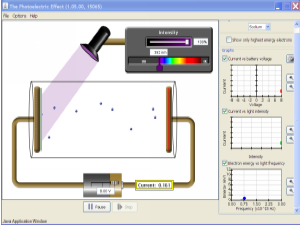
You can change the metal under investigation (we used zinc in class). You can also vary the wavelength and irradiance of the light. Notice that below the theshold frequency you can’t get any photoelectrons, even if you set the light to its brightest setting.