
Month: January 2012
S3 Homework – Resistance
Here is your homework on the resistance topic. Download the pdf with your questions by clicking on the download link below.
Please hand in your jotter no later than Tuesday 7th February.
Pupils going on the school ski trip should try hand their jotter in by the end of this week.

E-Book PDF: Open in New Window | Download
parallel circuits
Here is a short test to let you find out how much you’ve learned about parallel circuits so far. Click on the circuit diagram below to open the question page. You will be asked to enter values for V1, V2, A4 & A5.
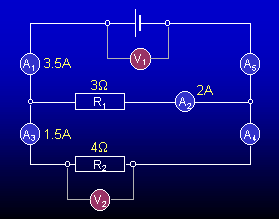
image courtesy of MATTER project
If you need some help to find all four values, click on the check answers button to view the working.
Are you ready for some more challenging questions on series and parallel circuits? Try this page.
capacitors – charge, energy and graphs
We’ve just completed the topic on capacitors in dc circuits, finishing off with a detailed study of the graphs obtained for current & voltage against time when a capacitor is charged or discharged through a series resistor. There are some additional notes and practice questions at the end of this post but please watch the clips first.
This introduction to capacitors from the nice people at Make Magazine is a good starting point.
The S-cool revision site has some helpful notes and illustrations on capacitor behaviour; try page 1 (how capacitors work) and page 2 (charging and discharging).
Here is a video that covers some of the areas we discussed in class. Ignore the maths at the end of each section of the film, you won’t need it. Notice how the man in the film uses a lightbulb, rather than an ammeter, to show when the current is large or small. Clever, eh?
httpv://www.youtube.com/watch?v=OfL3QWJSCu0
One use of capacitors you should know about is the flashing lamp. We’ll cover this application next week.
Blinking Neon Bulb (5F30.60A) from Ricardo Alarcon on Vimeo.
I compared normal electrolytic capacitors to a 10F supercapacitor, and we observed its superior performance in terms of energy storage. This video goes one step further and shows the fun you could have with an ultracapacitor. Do not try this at home!
Of course, you can always make your own capacitor with paper and electrically conductive paint.
Now download the pdf below. It contains notes to help with your prelim revision and some extra capacitor problems.
Thanks to Fife Science for the original pdf from Martin Cunningham.
E-Book PDF: Open in New Window | Download
beautiful equations
Those of you not out celebrating New Year might have spotted a programme called Beautiful Equations on the BBC schedule. The programme follows an artist as he asks about five famous physics equations.
One of the featured equations should be familiar to you from unit 1 of the AH Physics course;

Hopefully you recognise this as Newton’s equation for the gravitational force between two bodies. I have extracted the nine minutes or so relating to Newton’s work and embedded it below.
The link below will download the entire programme, which also looks at 
Podcast: Play in new window | Download