Here is the written paper from 1993.
There is a complete set of answers for this paper here.
This paper is reproduced to support SQA qualifications on a non-commercial basis according to SQA conditions of use.
with mr mackenzie
Here is the written paper from 1993.
There is a complete set of answers for this paper here.
This paper is reproduced to support SQA qualifications on a non-commercial basis according to SQA conditions of use.
We looked at projectiles and radiation today. The past paper questions we tried were taken from 1992-1999. I’ll post some of these papers on the blog so you can try some more of them. Note that the exam used to have two papers, paper I was multiple choice and paper II was the written paper.
There is a complete set of answers for these papers here. Sorry, that link seems to be dead now. You can get them here instead.
This paper is reproduced to support SQA qualifications on a non-commercial basis according to SQA conditions of use.
We are heading towards hardcore revision season now. I’ll be at the Easter study school on Monday and Tuesday to help with areas of difficulty. I’m also going to start posting some additional resources, sometimes it helps to get a different person’s perspective on the course.
Let’s start with a set of whole course notes I found online. It’s a pdf that summarises everything in the Higher course. You can use the download button or let iTunes do the downloading (easier option).
See you on Monday!

E-Book PDF: Open in New Window | Download
We used the grating equation
today to predict the location of bright fringes produced by a diffraction grating. Remember that d in this equation is the distance between adjacent lines in the grating and not the number of lines per metre/millimetre/inch. We’ll look at applications of this equation a little more this week, e.g. using a spectrometer to measure the angle so we can calculate the wavelength of the light used.
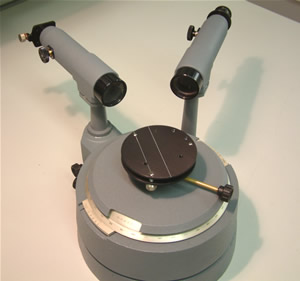
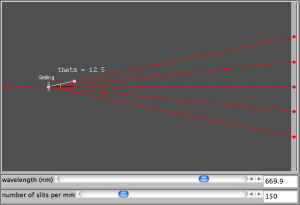
In the meantime, get some practice at using the grating equation with the simulation site shown below. You can select how many lines you would like per millimeter of grating and alter the wavelength. Try calculating the angle for the first or second order spots and then use the simulated protractor to see if you are correct. Click on the image below to get started.
We’ve been looking at interference recently. I found two nice simulations that you might want to try running at home to confirm your understanding of things like;
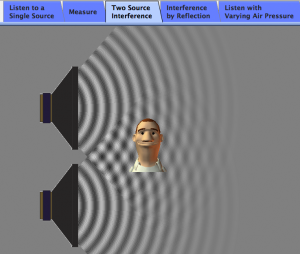
The first simulation is based on the interference of sound waves and is similar to the experiment we set up last week in class. Click on the image below to start the simulation, you will need Java for this to work. Make sure you choose the two source interference tab as shown in the picture.
The second simulation can be run as sound, light or water waves. I selected the light option for this screenshot. Click on it to run the simulation. You are free to run 2 sources or one source with a double slit barrier and adjust the amplitude and wavelength.
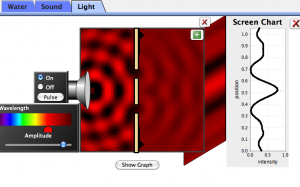
The view screen option is nice as it shows what the fringes would look like. You can also display a plot of light intensity (irradiance).