
Category: Health Physics

X-rays

By , November 14, 2010 12:29 pm

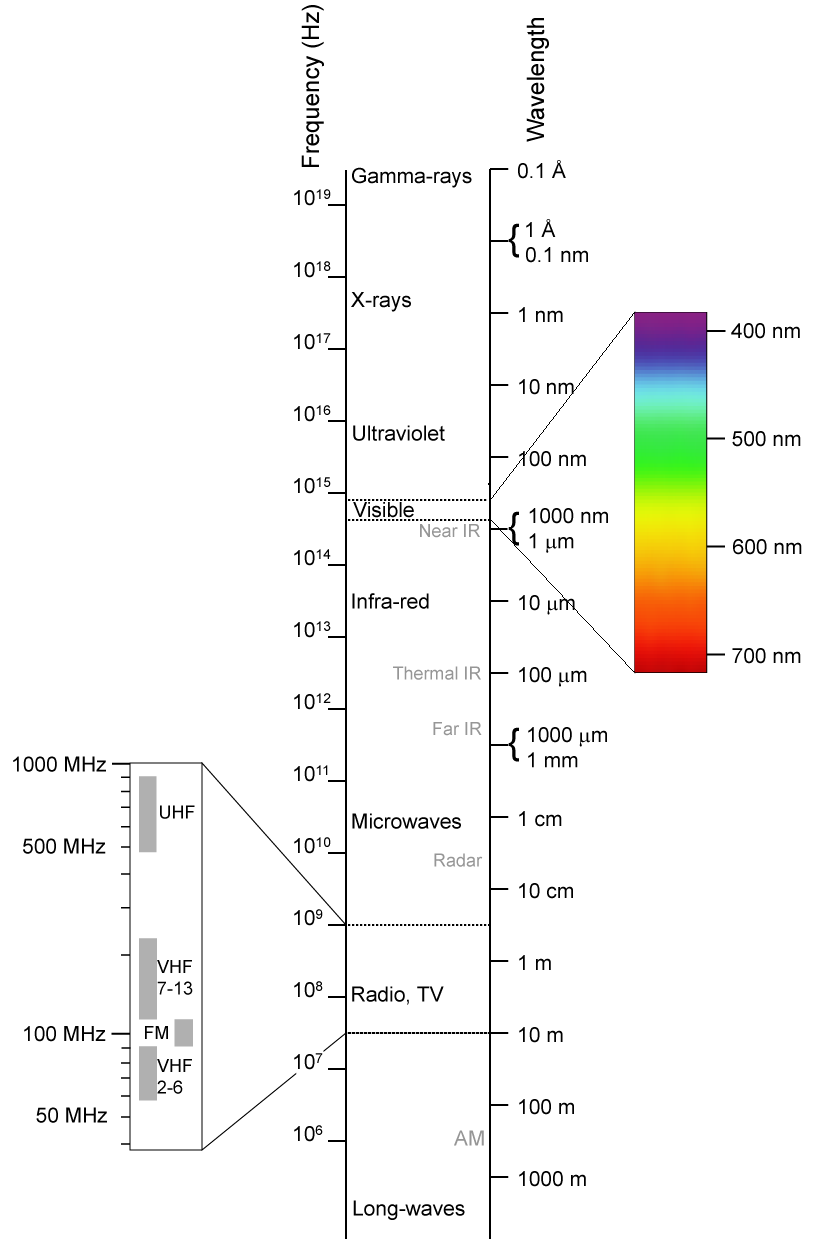
X-rays are a form of electromagnetic radiation.  They have a much higher frequency than visible light or ultraviolet.  The diagram below, taken from Wikipedia, shows where x-rays fit into the electromagnetic spectrum.

image by Materialscientist

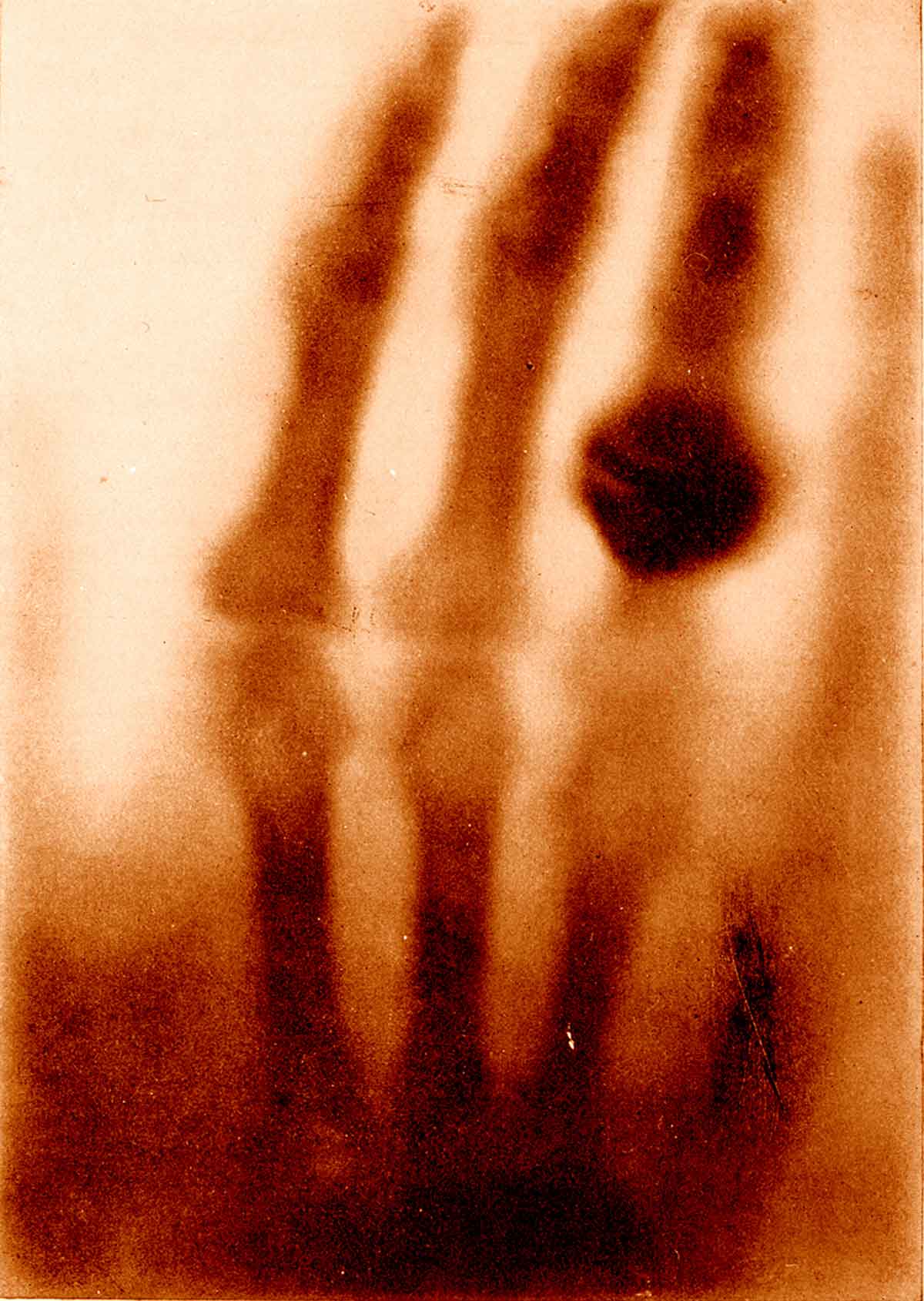
Wilhelm Röntgen discovered x-rays and the image below is the first x-ray image ever taken.  It shows Mrs. Röntgen’s hand and wedding ring.  The x-ray source used by Röntgen was quite weak, so his wife had to hold her hand still for about 15 minutes to expose the film.  Can you imagine waiting that long nowadays?

This was the first time anyone had seen inside a human body without cutting it open.  Poor Mrs. Röntgen was so alarmed by the sight of the image made by her husband that she cried out “I have seen my death!” Or, since she was in Germany, it might have been “Ich habe meinen Tod gesehen!” that she actually said.

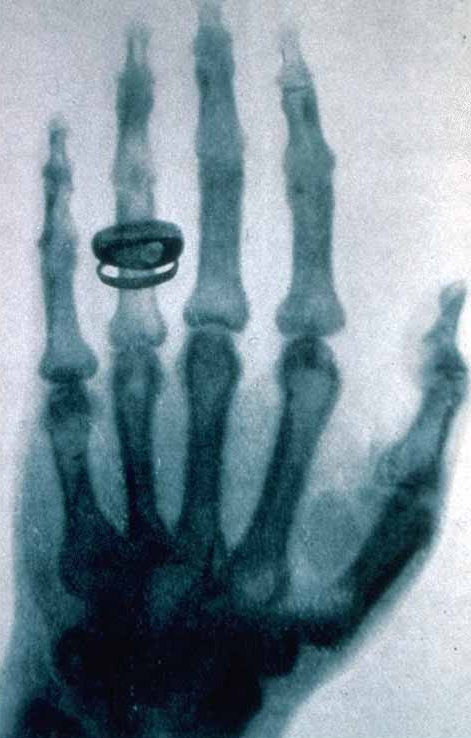
Röntgen continued to work on x-rays until he was able to produce better images. The x-ray below was taken about a year after the first x-ray and you can see the improvements in quality.

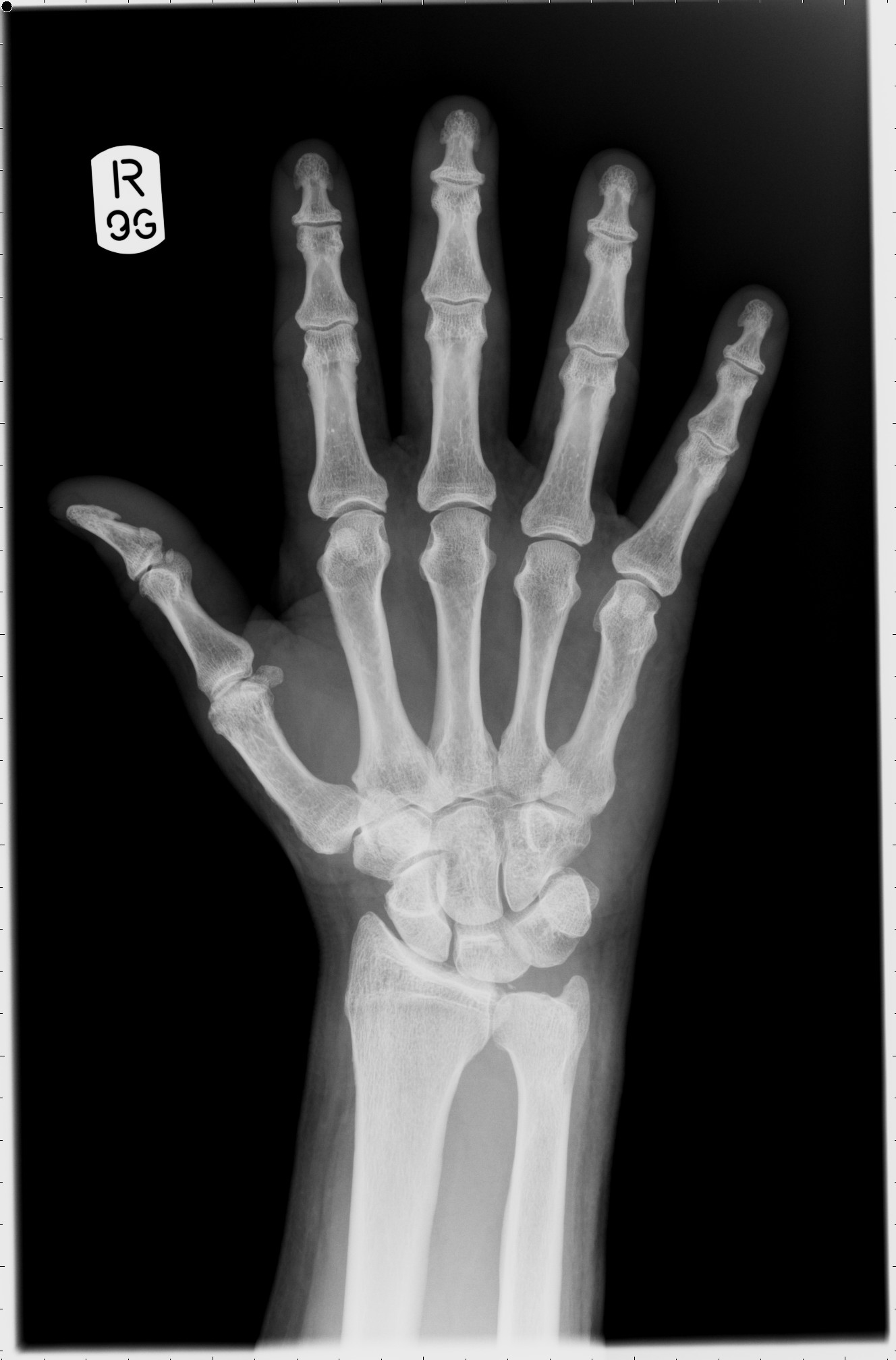
Notice that these early x-rays are the opposite of what we would expect to see today. They show dark bones on a lighter background while we are used to seeing white bones on a dark background, such as the x-ray shown below.  The difference is due to the processing the film has received after being exposed to x-rays.

In hospitals, x-rays expose a film which is then developed and viewed with bright light.  X-rays are able to travel through soft body tissue and the film behind receives a large exposure.  The x-rays darken the film. More dense structures such as bone, metal fillings in teeth, artificial hip/knee joints, etc. block the path of x-rays and prevent them from reaching the film.  Unexposed regions of the film remain light in colour.

Röntgen’s x-ray films would have involved additional processing steps.  The exposed films were developed and used to create a positive.  In creating a positive, light areas become dark and dark areas become light.  So the light and dark areas in Röntgen’s x-rays are the opposite of what we see today.  Our modern method makes it easier to detect issues in the bones as they are the lighter areas.

Röntgen was awarded the first ever Nobel Prize for Physics in 1901 for his pioneering work in this field of physics.

Medical imaging has come a long way since Röntgen’s discovery of x-rays.  This promotional video from German company Siemens outlines the advances that have been made since the early 20th century.

I have attached a recording of a short BBC radio programme about the first x-ray and what people in the Victorian era thought of these new images.  Click on the player at the end of this post or listen to it in iTunes.

4.3 – How to draw ray diagrams

By , November 14, 2010 11:28 am

I set you a task at the start of the week.  You were asked to complete a ray diagram at home and use 3 words to describe the image that was formed.

Here are 2 short videos to remind you how to draw a ray diagram.  The first video is an introduction to ray diagrams.

how to draw a ray diagram from mr mackenzie on Vimeo.

The second video looks at a ray diagram when the object is less than one focal length away from the lens.

ray diagram for objects closer than 1f from mr mackenzie on Vimeo.

Once the ray diagram is complete, we need to describe the image that has been formed.  The description must tell us about the size, orientation and type of image that is formed.

Size
If the image is larger then the original object, we say the image is magnified
If the image is smaller than the original object, we say the image is diminished.

Orientation
If the image is the same way up as the object, we describe it is upright.
If the image is upside down compared to the object, we describe it as inverted.

Type
If the object and image are on opposite sides of the lens, it is a real image.
If the object and image are on the same side of the lens, it is a virtual image.

4.4 half-life calculations

By , August 31, 2010 10:28 pm

We have almost completed the health physics unit and have spent some time in class practising half-life problems.  You might find the attached instructions helpful as you prepare for the unit test.

4.4 health physics HW

By , August 31, 2010 9:34 am

I have attached your HW on health physics. It covers material from before the holidays so you may want to look over your jotter notes to help complete the questions.

Please hand in your HW no later than Tuesday 7th September. Late jotters will not be accepted.

Geiger-Müller tube

By , August 19, 2010 8:29 pm

We examined the operation of a Geiger-Müller counter today.

image by Theresa Knott

The Geiger-Müller (GM) counter is used to detect ionising radiation such as alpha and beta particles or gamma rays.  The radiation enters through a very thin window at one end of the tube.  This window is usually made of mica.

Mica flakes.  Photo by Rpervinking

Mica is a mineral that forms in layers called sheets.  These sheets can be split apart into very thin layers, so thin that even an alpha particle can pass through it (remember that alpha particles can be stopped by something as thin as your skin or a sheet of paper).  The mica window prevents the argon inside the tube from escaping and also stops air from getting into the tube.

When radiation enters the tube and collides with an argon atom, an electron may be knocked off the atom – we call this process ionisation.  When ionisation occurs, a positively-charged argon ion and a negatively-charged electron are produced.  The argon ion is attracted to the outside wall of the tube, which is connected to the negative terminal of the power supply, while the electron is attracted to the central electrode, which is kept at a high positive voltage – typically 500V.

A small pulse of current is produced each time an electron reaches the central electrode.  These pulses can be counted by an electronic circuit and a displayed on a 7-segment display.  Sometimes a small speaker is added to the system to produce a click for each pulse.  On its own, the GM tube cannot tell the difference between alpha, beta and gamma radiation.  We need to place different materials (e.g. paper, aluminium, lead) in front of the mica window to discover which type of radiation is responsible for the reading.

Here is a short video demonstrating the use of a Geiger-Müller tube.

Free physics software

By , March 5, 2009 4:34 pm

I’ve had an email from Yenka to say that they are now offering many of their products for home use – free of charge!  I think Yenka is the new name for Crocodile Clips, the company who made Crocodile Physics and Crocodile Technology.  Their software allows you to create your own experiments to learn about

  • motion – SG transport, Int2 unit1, Higher unit1, AH unit1
  • electricity – SG using electricity, Int2 unit1, Higher unit2, AH unit2
  • light and sound – SG health physics, Int2 unit3, Higher unit3, AH unit3
  • electronics – Int1 applied practical electronics, SG electronics, Int2 unit2, Higher unit2

They also have some chemistry products you might find helpful.

The software is free but you can only use it at home.  Why not download it and see if you find it useful.

Standard Grade half-life calculations

By , December 28, 2008 3:35 pm

For those of you preparing for S Grade prelims straight after the Christmas holidays, I have added a 6 page summary on radioactivity & half-life calculations with worked examples and extra questions (with answers) for you to try.

You’ll find the pdf file containing all this radioactive goodness in the Health Physics section of the Standard Grade revision page.

Cancer treatment by Chemotherapy

By , September 2, 2007 2:48 pm

We don’t need to cover chemotherapy as part of the Standard Grade Phyics course but I thought you might be interested in how it works, now that we have looked at the use of Radiotherapy.  The attached pdf file contains some notes on chemotherapy taken from the CancerHelp UK website.

Chemotherapy notes

S4 – laser eye correction

By , August 20, 2007 9:28 pm

We’ve been looking at the various uses for lasers in surgey, including the correction of eyesight.  I found this site that shows how one company does this in their clinic.  The animation does  a pretty good job of explaining the procedure.

Panorama Theme by Themocracy