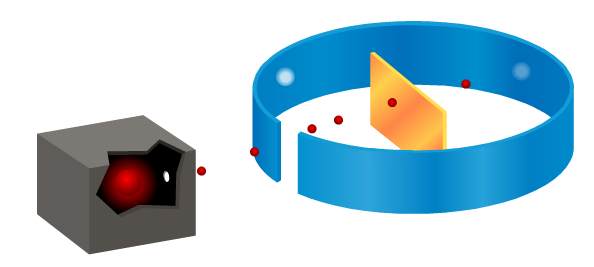
In the last part of the Higher course, we looked at the structure of the atom. Rutherford scattering of alpha particles fired at a very thin sheet of gold foil provided the evidence to develop our understanding of the atom from a “plum pudding” model to a “nuclear” atom – where most of the matter and mass are concentrated in the centre, or nucleus, of the atom.
There is a really good youtube video about Rutherford & alpha particle scattering - watch the first 5 minutes only, it goes on to another topic after that. You can also follow the link below (the download link at end of post) to watch an animation of the alpha particle scattering experiment and follow how the results changed our view of the atom.
These notes cover the whole of the first unit.
We covered SHM at the end of the 1st unit of the AH course.
We’ll complete the course by the end of this week and that means you need to start consolidating all the material we have covered over the year. To help you get underway I have grabbed some AH revision materials in pdf format and am in the process of putting together a series of podcasts with pdf attachments – remember how much you complained that the Higher class were getting stuff on iTunes and you weren’t?
The first set of notes covers circular motion.
You will get your first chance to sit the unit 3 NAB next week. In the meantime, I have attached a set of revision note for unit 3 to help with your revision.
If you have to resit the unit 1 NAB on Wednesday (29th), here are some links to help with your revision.
whole course notes
unit 1 summary (PowerPoint)
unit 1 revision notes (pdf)
notes on vectors (pdf)
St. Kentigern’s Academy revision notes: units 1.1 & 1.2, 1.3 & 1.4 and 1.5 & 1.6 there is also a revision test and you can check your answers.
If you are resitting the unit 2 NAB next Wednesday (29th April), you might want to look at the following revision sites:
XPhysics unit 2 revision
TPD, EMF and internal resistance
Unit 2 summary (Powerpoint)
Whole course summary notes (pdf)
St. Kentigern’s Academy Notes: unit 2.1, unit 2.2, unit 2.3, unit 2.4, revision questions, answers to revision questions